
PCOS Is Now PMOS: A Tumble Toward Diabetes

Fact checked by Diabetes.co.in Medical Review Board
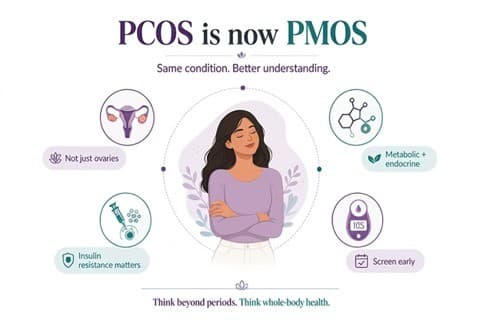
For decades, the condition we called PCOS was introduced to women as a problem of the ovaries. It sounded simple enough: a cystic appearance on ultrasound, irregular periods, and maybe some acne or hair changes. But the real story was always more complex. The ovary did not tell the whole truth. [1]
The name “PCOS” stuck because it was easy to remember. Over time, it quietly shaped how everyone thought about the condition: as a gynecologic disorder, a reproductive problem, or at best, a hormone imbalance limited to periods and fertility. The deeper metabolic reality - insulin resistance, dysglycaemia risk, and long‑term health implications - stayed in the background, often missed in the first consult and sometimes missed altogether. [2]
In 2026, that began to change. A global consensus process published in The Lancet proposed a new name: polyendocrine metabolic ovarian syndrome (PMOS). The renaming was not cosmetic. It was a correction of decades of incomplete thinking.[3]
From PCOS to PMOS: A Post‑Mortem of the Old Name
The term “polycystic” came from ultrasound appearances - ovaries with many small follicles arranged like a string of pearls. But those were not true cysts. They were follicles that had started to develop but never completed ovulation. The “cyst” part of the name was a misnomer, and it mattered more than people realized.
By focusing on the ovaries, the old name directed attention away from the real engine of the disease: the way the body handles insulin and hormones. It made it too easy to see PCOS as a merely reproductive label, and not as a lifelong endocrine‑metabolic condition with reproductive consequences.[4]
That is why the shift to PMOS deserves to be taken seriously. The biology is the same. The understanding is different. The name is finally trying to catch up with the science.[5]
Why PMOS Is Better Than a New Acronym
You can think of PMOS as a more honest description of the same condition. The P‑M‑O‑S sequence now reads:
- Polyendocrine: the problem is not just the ovary, but a network of glands and tissues working together.
- Metabolic: the root of much of the trouble is insulin resistance and dysregulated metabolism.
- Ovarian: yes, the ovaries are involved, but they are responding to a metabolic signal, not generating the entire disease on their own.[2]
This is not just academic wordplay. It changes what clinicians should ask at the first visit:
- Are periods regular?
- Are there signs of acne, hirsutism, or irregular ovulation?
- And crucially, what is the metabolic risk profile?
A “Prediabetes‑Like” Condition - But Not Quite
PMOS is not diabetes, but it can sit on the same pathway that leads toward diabetes if risk is not recognized early. That is why some clinicians describe it as “prediabetes‑like,” although that phrase must be used carefully. PMOS and prediabetes are not the same diagnosis, but they often travel similar metabolic roads.[6]
At the cellular level, many women with PMOS show insulin resistance: the body’s tissues respond less efficiently to insulin, so the pancreas responds by producing more of it. During that phase, blood glucose can still look normal because of this extra insulin. That is why a normal fasting glucose is not reassuring enough.[6]
The 2023 international evidence‑based guideline for PCOS explicitly states that oral glucose tolerance testing (OGTT) is the most accurate way to assess glycaemic status when feasible. It can detect abnormalities that fasting glucose alone will miss, especially in young women and those planning pregnancy.[7]
Why Normal Glucose Can Be a Trap
The real danger in PMOS is the long phase of silent metabolic stress. Insulin resistance can exist for years before blood glucose becomes abnormal, and during that time, the ovaries, liver, muscle, and fat tissue are already under strain.[8]
Excess insulin can:
- Stimulate the ovaries to produce more androgens.
- Worsen acne and unwanted hair growth.
- Disrupt ovulation and menstrual cyclicity.
- Further worsen insulin resistance itself.[11]
In other words, the reproductive symptoms are often downstream effects of a metabolic problem that started earlier. That is why the new name PMOS is so important: it reminds everyone that the metabolic issue is there from the beginning, even if the glucose machine has not yet sounded the alarm.[9]
A Condition That Crosses Boundaries
PMOS does not fit neatly into one clinic room. It often sits at the junction of gynecology, endocrinology, primary care, and mental health. A young woman may first see a gynecologist for irregular periods, a dermatologist for acne, or a fertility specialist when pregnancy is planned, and only later a physician for glucose issues.[12]
The rename is trying to bring those pieces together. PMOS is not just a reproductive label. It is a whole‑body diagnosis that should be taken seriously from the very first visit.
The Global Burden, Told Simply
The 2026 consensus and supporting reports describe PMOS as affecting more than 170 million women worldwide, roughly one in eight women of reproductive age. A global meta‑analysis of 2024 estimated an overall prevalence of about 9.2% when pooling data across regions, with wide variation depending on how the condition is diagnosed (NIH, Rotterdam, or AES criteria).[10]
Across continents, prevalence estimates differ, and the quality of evidence is not equal everywhere. In Europe and the Americas, studies using Rotterdam criteria often report higher rates; in other regions, the data are patchier but still point to a substantial burden. This variability is important for readers, because it shows that PMOS is not a niche disorder of a single population; it is a common, global endocrine‑metabolic condition. [10]
What Should Happen at Diagnosis?
The 2023 international guideline offers a clear framework that remains relevant under the new name. At diagnosis, PMOS should trigger a broader conversation, not just a hormonal prescription. That includes:
- Menstrual and reproductive history.
- Signs of hyperandrogenism (acne, hirsutism, alopecia).
- Weight, waist circumference, and blood pressure.
- Lipid profile and OGTT (or, when needed, fasting glucose and HbA1c).
Glycaemic testing should occur early, not years later, and be repeated periodically depending on risk factors. The goal is not to scare patients, but to catch risk before it becomes damage. [13]
A Message That Fits Real Life
For mothers reading this on Mother’s Sunday, and for young women trying to understand a confusing diagnosis, the message can be simplified:
PMOS is a condition where the body has trouble using insulin the way it should. That hormonal‑metabolic imbalance can disturb ovulation, cause acne or excess hair growth, and increase the chance of future blood sugar problems. It is not the same as diabetes, but it is a warning sign that needs attention. [4]
This explanation is honest, kind, and evidence‑based. It avoids fear while still taking the risk seriously. It also reminds everyone that PMOS is manageable, especially when it is recognized early and treated thoughtfully.
Frequently Asked Questions (Clinician‑Friendly, Patient‑Friendly)
1. What is PMOS?
PMOS is the new name for PCOS, chosen to reflect its endocrine and metabolic nature more accurately.
2. Why was PCOS renamed?
Because the old name overemphasized the ovaries and underrecognized the metabolic biology.
3. Are the symptoms the same?
Yes. Irregular periods, acne, hirsutism, anovulation, and metabolic features remain central. Academic.
4. Are there true ovarian cysts?
No. The ultrasound pattern is made up of arrested follicles, not true cysts.
5. Is PMOS only a fertility disorder?
No. Fertility may be affected, but PMOS also carries metabolic risk over the long term.
6. Is PMOS the same as diabetes?
No. But it is associated with a higher risk of impaired glucose tolerance and later type 2 diabetes.
7. Is PMOS the same as prediabetes?
No. That is only a rough analogy, not a formal diagnosis.
8. Can blood sugar be normal even with PMOS?
Yes. Insulin resistance may be present long before glucose becomes abnormal.
9. What is the best test for sugar risk?
OGTT is preferred when feasible.
10. Is fasting glucose enough?
Not always. It can miss early abnormalities.
11. Why does PMOS cause acne and hair growth?
Excess insulin can increase ovarian androgen production, which drives these symptoms.
12. Why do periods become irregular?
Because ovulation may not occur regularly when this hormonal‑metabolic network is disturbed.
13. How common is PMOS worldwide?
About one in eight women worldwide, with regional variation in reported prevalence.
14. Do rates differ by continent?
Yes. Estimates vary by region and diagnostic criteria, and some continents have thinner data than others.
15. Can thin women have PMOS?
Yes. Lean PMOS is well recognized and often underdiagnosed.
16. Should metabolic testing be done at diagnosis?
Yes. That is a core recommendation of the 2023 guideline.
17. What should be tested?
Glycaemic status, blood pressure, lipids, and other cardiometabolic risk markers.
18. Can PMOS be managed?
Yes. Early lifestyle intervention and appropriate medical therapy can improve symptoms and reduce long‑term risk.
19. Why does the new name matter to patients?
Because it makes the metabolic part of the disease harder to ignore and helps align care with the true nature of the condition.
20. What is the main takeaway message?
PMOS is not just about ovaries or periods. It is a whole‑body endocrine‑metabolic condition that deserves early recognition, thoughtful management, and long‑term follow‑up.