This is a very important and practical question. You are right to be cautious.
40 IU and 100 IU insulin refer to concentration, not strength of the medicine.
- U-40 insulin means 40 units of insulin in 1 ml.
- U-100 insulin means 100 units of insulin in 1 ml.
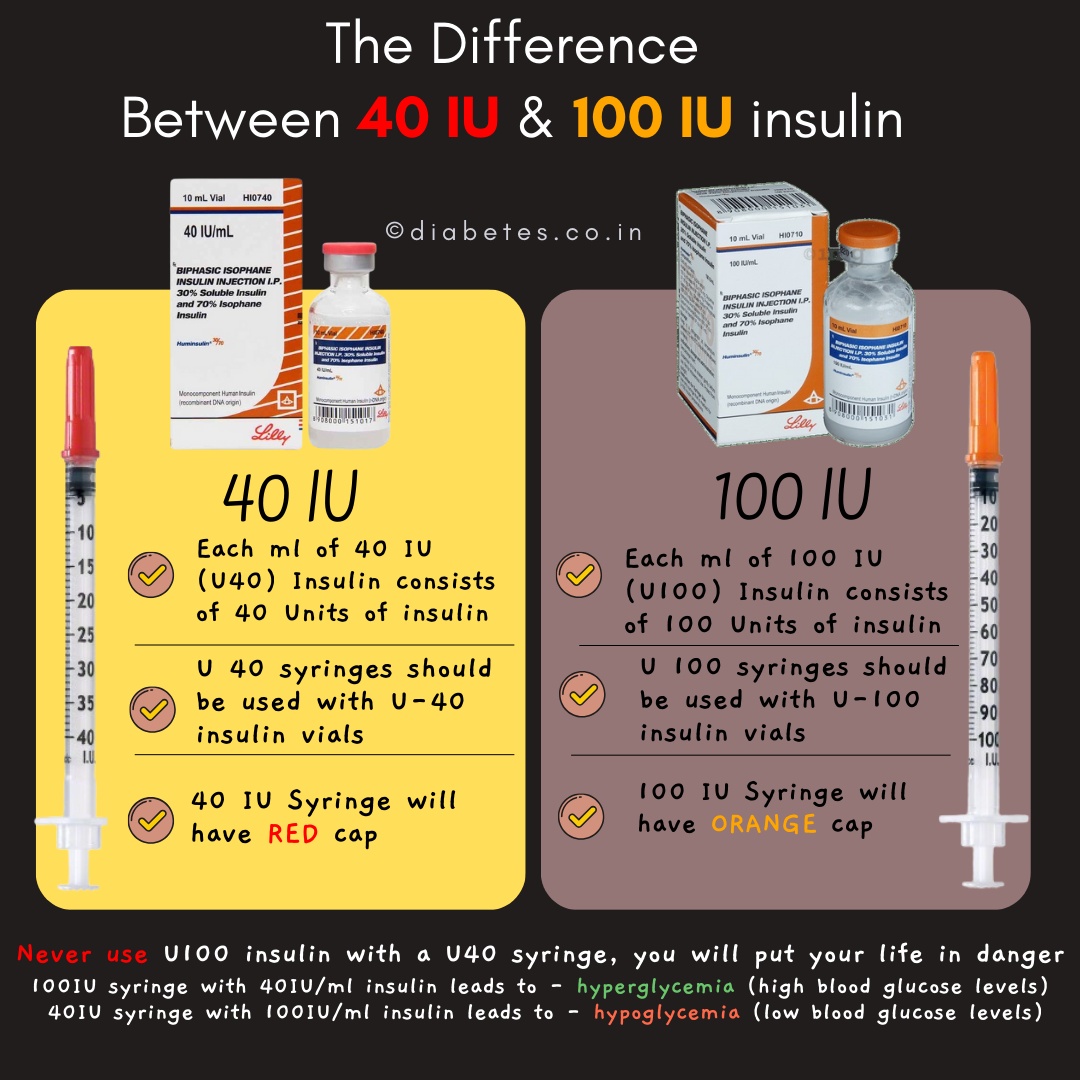
So, U-100 insulin is 2.5 times more concentrated than U-40 insulin. That is why the syringe must always match the insulin concentration.
Why mixing them is dangerous
- If U-100 insulin is drawn into a U-40 syringe, the person receives much more insulin than intended. This can cause severe hypoglycemia, seizures, or even coma.
- If U-40 insulin is drawn into a U-100 syringe, the dose becomes too low, leading to high sugars and poor control.
This is exactly what happened in your grandmother’s case.
Simple way to remember
- U-40 insulin = U-40 syringe only.
- U-100 insulin = U-100 syringe only.
Never mix and match.
How to identify them
- U-40 insulin usually has a red cap and U-40 marking on the vial.
- U-100 insulin usually has an orange cap and U-100 clearly written.
- Syringes also have clear markings showing U-40 or U-100.
Always read the label before drawing insulin, even if you have been using it for years.
Why two types exist
Historically, U-40 was commonly used in India. Over time, U-100 became the global standard because it allows smaller injection volumes and better accuracy. Today, most modern insulins are U-100.
Key precautions for patients and families
- Never change syringe type without consulting your doctor.
- Keep only one type of syringe at home if possible.
- Educate elderly family members and caregivers.
- If switching from U-40 to U-100 insulin, dose recalculation must be done by a doctor.
Insulin itself is safe. Most insulin-related emergencies happen due to dose or syringe mismatch, not because insulin is harmful.